Residential driveway paving in Louisiana comes down to four linked decisions: material, base and pavement thickness, drainage, and permits. Asphalt, concrete, and pavers each suit different budgets, loads, and sites. Because soils, ditches, and road ownership change from one property to the next, the section and grading that fit your driveway should follow an on-site evaluation rather than a general rule.
Key Takeaways
- What is under the surface usually decides how the driveway performs. Thickness of asphalt or concrete gets the attention in a quote, but subgrade condition, base thickness, and compaction carry the load.
- Material choice is a trade-off, not a ranking. Asphalt is generally quickest to place and simplest to patch, concrete is rigid and wears well, and pavers cost more but can be lifted and reset unit by unit.
- Drainage belongs in the scope before anyone quotes a price. Slope, edge treatment, and where water goes at the road are design decisions, not details to settle on paving day.
- Permit responsibility follows road ownership. A connection to a state highway is handled through Louisiana DOTD; parish and municipal roads follow parish or city rules, and the agency normally sizes any culvert.
- Compare bids scope to scope, not by price per square foot. Excavation depth, base thickness, drainage work, and edge details explain most of the difference between two proposals for the same driveway.
A driveway is the one piece of pavement on your property you use every day. It is also the one most likely to be quoted three different ways by three different contractors. One proposal lists a surface thickness and a price. Another prices concrete and says nothing about the ditch. A third wants to talk about excavation and grading before it will talk about the surface at all.
This guide explains what separates those proposals. It covers how asphalt, concrete, and pavers compare, how Louisiana heat, rainfall, and clay soils affect the decision, what actually drives cost, when permits and culverts come into play, how the site is prepared, how the work is sequenced, when you can use the driveway, and how to read the problems that show up later. The goal is not to pick your pavement from a webpage. It is to help you ask better questions before you sign anything.
Driveway Material Comparison: Asphalt vs. Concrete vs. Pavers
Treat the table below as a starting frame, not a specification. Every row shifts with your soil, your vehicles, your drainage, and the scope each contractor is pricing. Published thickness ranges come from asphalt and concrete industry guidance for residential work, and the right section for your driveway should still be confirmed on site.
| Factor |
Asphalt |
Concrete |
Pavers |
| Installed cost |
Usually the lowest of the three for a comparable area, though excavation, base, and drainage can change the total substantially |
Typically higher than asphalt for the same area. Reinforcement and jointing add scope |
Typically the highest of the three because of unit cost and labor time |
| Typical structure |
Compacted hot-mix asphalt over a compacted aggregate base, or full-depth asphalt on a prepared subgrade |
A jointed slab, sometimes reinforced, over a prepared and compacted base |
Units set on a bedding layer over a compacted aggregate base, held by an edge restraint |
| Commonly cited thickness |
Industry guidance for residential drives often describes roughly 2 to 3 in of compacted asphalt over 4 to 8 in of base, or about 4 to 6 in of full-depth asphalt on a prepared subgrade |
Residential slabs commonly start around 4 in, with more where heavier or repeated loads, local requirements, or a project design justify it |
Unit thickness is set by the paver product; the base under it is sized for the loads and soil, and is usually the larger variable |
| Install time |
Placement is often a single day once the site is prepared. Site work adds days |
Forming and placing often runs one to two days, followed by a curing period before vehicle use |
Longest of the three because units are placed individually |
| Service life |
Varies widely with base support, drainage, loads, and maintenance rather than with the surface alone |
Long wearing when jointed, based, and drained well; movement in the soil below shows up as cracked or offset panels |
Units are durable; performance depends on the base, the edge restraint, and keeping joint sand in place |
| Maintenance |
Crack sealing, periodic seal coating, protecting unsupported edges |
Joint sealing, cleaning, occasional surface sealing |
Replenishing joint sand, controlling weeds and ants, resetting settled units |
| Repairability |
Patching and overlays are straightforward and blend reasonably well |
Partial repairs are visible; replacement is often done panel by panel |
Individual units can be lifted and reset, which is the main advantage |
| Notes for Louisiana sites |
Flexible surface tolerates small movements in the subgrade better than a rigid slab. Needs positive drainage and supported edges |
Rigid, so uniform base support and a sensible joint layout matter on clay soils |
Heavy rainfall can move bedding and joint sand where edge restraint or drainage is weak |
When Asphalt Is the Right Choice
Asphalt suits most residential driveways in Central Louisiana that carry passenger vehicles and light trucks, especially where the owner wants the surface usable quickly and repairable later. Because asphalt is a flexible pavement, small movements in the ground below tend to show as surface cracking that can be sealed, rather than as a broken panel that has to be removed.
It is also the easier material to extend or resurface. If the base is still supporting load and the surface is worn, an overlay is often a realistic option, which is why asphalt resurfacing is a common mid-life step on driveways that were built well the first time. That advantage disappears if the base or drainage is the actual problem.
When Concrete Makes More Sense
Concrete is worth considering where the driveway will hold concentrated or standing loads, where a lighter surface color is wanted, or where the owner prefers a rigid surface with less frequent surface treatment. Trailer jacks, boat and RV tongue weight, and vehicles that sit in one spot through Louisiana summer afternoons are all easier on a rigid slab than on a thin asphalt section.
The trade-off is that a slab has less tolerance for uneven support. Joint layout, slab thickness, base uniformity, and curing all influence whether cracking stays in the joints where it was planned. Guidance for residential concrete construction, including ACI 332 and its companion guide, treats joints and base preparation as part of the design rather than as finishing details. Concrete paving is available as an option where it fits the site better than asphalt.
When Pavers Are Worth the Investment
Pavers make sense when appearance is a priority, when the driveway is short enough that unit labor stays reasonable, or when the ability to lift and reset a small area has real value. A settled corner near a downspout can be pulled up, regraded, and relaid without a patch line running across the whole drive.
They are less forgiving of a weak base than the price tag suggests. Without a properly compacted base and a solid edge restraint, units migrate outward, joints open, and sand washes out during heavy rain. Budget for the base and the edges, not just for the pavers.
Are Permeable Pavers a Good Fit for Louisiana?
Sometimes, but the soil below usually decides. Permeable systems are designed to let water pass through the surface into an open-graded stone reservoir and then into the soil. That last step is the limitation. Stormwater guidance generally treats soils in hydrologic soil groups C and D, which are typically higher in clay and poorly drained, as unsuitable for infiltration-based permeable pavement without additional design, and notes that placing these systems over fine-textured soils can leave water standing on the surface.
EPA guidance on permeable pavements makes a related point: clay subgrades may call for more base material for structural support or storage, and low-infiltration sites may need deeper layers or underdrains, all of which raises cost. Surface clogging from sediment is the other ongoing issue, since permeable systems need periodic cleaning to keep working. On a Louisiana lot with heavy clay and a roadside ditch nearby, a conventional pavement with well-planned surface drainage is often the more practical answer. If you are drawn to a permeable system, start with a soil evaluation, not a product brochure.
How Louisiana Conditions Affect Your Driveway Choice
Heat, Humidity, and Heavy Rainfall
Central Louisiana gives pavement a long, hot, wet year. National Weather Service climate normals for the Alexandria 5 SSE station in Rapides Parish show average July and August highs near 92 degrees F and roughly 59 inches of precipitation annually, spread across every month rather than concentrated in one season.
Two practical consequences follow. First, water is nearly always available to get into a pavement structure, so joints, cracks, edges, and grading matter more here than surface appearance does. Second, heat affects asphalt behavior under concentrated load, which is why point loads such as trailer jacks, motorcycle stands, and vehicles parked in the same spot during the hottest part of the day are worth planning around. Freeze and thaw damage, the mechanism that drives pavement deterioration in northern states, is a minor factor in this market. Water and soil movement are the local drivers.
Soil Movement and Subgrade Stability
Much of Louisiana sits on fine-grained soils that change volume with moisture. Research on expansive soils in Louisiana describes how swelling and shrinking soils cause uneven settling and shifting that shows up as cracking in foundations, streets, driveways, and sidewalks, and notes that this hazard is distinct from long-term subsidence. Central and northern parts of the state are described in the geotechnical literature as having stiff clays with high plasticity.
For a driveway, that means the same slab or asphalt section can perform differently on two lots in the same neighborhood. It also means moisture control around the pavement, including where roof runoff lands and how the ditch drains, is part of pavement performance rather than a landscaping question. It does not mean your driveway is doomed, and it does not mean every crack you see is a soil problem. It means the subgrade deserves a look before the section is chosen.
What a Driveway Paving Project Costs
There is no honest square-foot number that covers every driveway in this market. The same 800 square feet can be a straightforward overlay on a stable base or a full rebuild with excavation, undercut, a new culvert, and regrading. What follows is what moves the number, so you can read a quote instead of guessing at one.
What Drives the Total Price (Size, Material, Site Conditions)
Size sets the material quantity, but rarely the full price. Long, narrow driveways cost differently than short, wide ones because of edge length, turning areas, and access. Material choice sets a baseline, and site conditions decide how far the real scope drifts from that baseline.
- Removal and disposal. Existing asphalt, concrete, or contaminated gravel has to be broken out and hauled off.
- Excavation depth. Getting to a competent subgrade sometimes means digging deeper than planned.
- Subgrade condition. Soft or wet areas may need undercut and replacement, a separation fabric, or a designed stabilization treatment.
- Base quantity and compaction. Aggregate thickness and the effort to place and compact it in lifts.
- Drainage work. Regrading, culvert work, ditch cleaning, edge treatment, or tie-ins to existing structures.
- Access and haul. Distance from the plant or quarry, tight lots, overhead limbs, and utility conflicts all affect production.
- Permits and inspection. Agency requirements where the driveway meets a public road.
A lower price per square foot can simply mean a thinner section, less excavation, or no drainage work. That is why the useful comparison is scope to scope. Ask each contractor to write down excavation depth, base type and compacted thickness, surface thickness and whether it is measured loose or compacted, drainage items, edge details, and what is excluded. Then compare like for like.
Excavation, Base, and Drainage Add-Ons
The items most often left out of the cheapest proposal are the ones that determine whether the driveway holds up: enough excavation to reach firm ground, enough compacted base to spread the load, and a drainage plan that moves water off the surface and away from the structure. When these show up as add-ons after work starts, the project gets more expensive and more disruptive than it needed to be.
The practical way to avoid that is a site visit before the scope is written. Precision Blacktopping LLC provides free estimates and on-site assessments across Louisiana, Mississippi, and Texas. Call (318) 955-3100 or request a free estimate and have the driveway looked at before you compare numbers.
Planning Your Driveway Project
Measuring Size, Width, and Layout
Start by measuring what you actually need to do, not just the footprint of what is there. Single-vehicle driveways are commonly built in the range of 9 to 12 feet wide, and two-vehicle drives are commonly 16 to 20 feet, with extra width where doors open next to a wall, fence, or drop-off. These are layout conventions rather than requirements, and your garage opening, lot width, and local rules can override them.
Then plan the movements. Where do you turn around? Where does a delivery truck stop? Do you back onto a road where sight distance matters? Adding a turnaround or a parking apron during the original project is far cheaper than tying a new section into cured pavement later. Where the driveway meets the road, the flare or radius often needs to follow the agency detail rather than your preference.
Evaluating Soil, Existing Pavement, and Drainage
Three things get evaluated before a section is chosen: what the ground is like, what is already there, and where the water goes. On a rebuild, the condition of the existing pavement tells you something about the base. Widespread interconnected cracking, rutting in the wheel paths, and areas that feel soft under a loaded vehicle point toward the structure rather than the surface. Isolated cracks in an otherwise sound surface point somewhere else.
None of that is a diagnosis from a distance. Two driveways with identical surface cracking can need very different work depending on what is under them. What a contractor should be doing on the estimate visit is looking at the low spots, the edges, the ditch or curb line, the roof drainage, and the areas that stay wet, and telling you what they can and cannot know without opening the ground.
Determining Pavement and Base Thickness for Your Vehicle Loads
Thickness is where general advice does the most damage. Asphalt industry guidance for residential driveways describes ranges rather than a single number. State asphalt pavement association guidance, for example, describes full-depth asphalt driveways where 4 inches may be adequate but 5 or 6 inches provides more margin across a wider range of climates and loads, and notes an alternative approach of roughly 6 to 8 inches of compacted aggregate under a thinner asphalt section. Those are starting points that assume a prepared, compacted subgrade.
What moves the number for your driveway is the combination of subgrade support, drainage, and the heaviest loads that will actually use it. A daily commuter is a different load case than a dually pulling a loaded trailer, a boat that sits on the drive all season, or a concrete truck during a future home project. One more distinction to hold onto when reading quotes: loose thickness and compacted thickness are not the same measurement. Asphalt is placed thicker than it finishes. If a proposal says three inches, ask whether that is before or after compaction.
Permits, Culverts, and Right-of-Way Requirements
Requirements differ by jurisdiction, so treat this section as a map of who to ask rather than a list of rules that apply to your address. The first question is always the same: who maintains the road you are connecting to?
When a Driveway Permit Is Required
Work inside your own property line generally raises fewer questions than work inside the public right-of-way, which typically extends past the pavement edge toward your front property line. Connections to a Louisiana state highway are handled through the Louisiana Department of Transportation and Development, which issues an access connection permit for single-family residential driveways covering the connection itself, the approved driveway material within the right-of-way limits, culvert size and length, driveway width and radius, and any required hydraulic review.
Parish and municipal roads follow local rules. Louisiana parish policies commonly require a permit for new driveways and culvert installations within parish rights-of-way in unincorporated areas, and state plainly that driveways on state roadways are permitted by DOTD instead. Inside city limits, the city usually handles it. Replacing a surface in place sometimes needs no permit at all, while widening, relocating, or adding a connection usually does.
Driveway Aprons and Curb-Cut Requirements
The apron is the transition between the road and your driveway, and the portion inside the right-of-way is generally built to the agency detail rather than to the homeowner preference. Agencies commonly specify the approved surfacing material within the right-of-way, the driveway width, the radius or flare, and how the connection ties into the existing pavement or curb. Where a curb exists, cutting or modifying it is typically part of the permitted work, not a separate decision your contractor can make on the day.
This matters for scope and for money. If your permit approves a specific apron material and width, that requirement should appear in the proposal before work begins.
When a Culvert Is Needed
A culvert is needed when the driveway crosses a roadside ditch or drainage course, and the water needs to keep moving under the driveway instead of around it or across the road. The key point for homeowners is that the size and grade of the culvert are normally determined by the agency, not by the homeowner or the contractor. Louisiana parish policies commonly state that a parish road superintendent or designee determines the acceptable driveway location, the correct culvert size, and the required grades, and that an application can be denied where a properly sized culvert cannot be installed on grade without impeding drainage.
Undersized or misplaced pipe is one of the more expensive mistakes on a rural driveway, because the fix usually means taking the new driveway back apart. Existing culverts deserve a look too. A crushed, silted, or separated pipe under an old driveway is a good reason to address drainage during the rebuild rather than after.
Connecting to Parish or State-Maintained Roads
Confirm road ownership first, then contact the right office. For a state highway, that is the DOTD district permit specialist for your area. For a parish road, that is the parish public works or road department. For a city street, that is the municipality. Parish police juries in Louisiana derive authority over road drainage from state law, which is why ditch and culvert work in the right-of-way is treated as a public drainage question rather than a private one.
Ask the agency what it needs before scheduling paving. Application review, a location visit, culvert sizing, and an inspection after installation all take time, and they can affect the sequence of the work.
Site Preparation and Base Construction
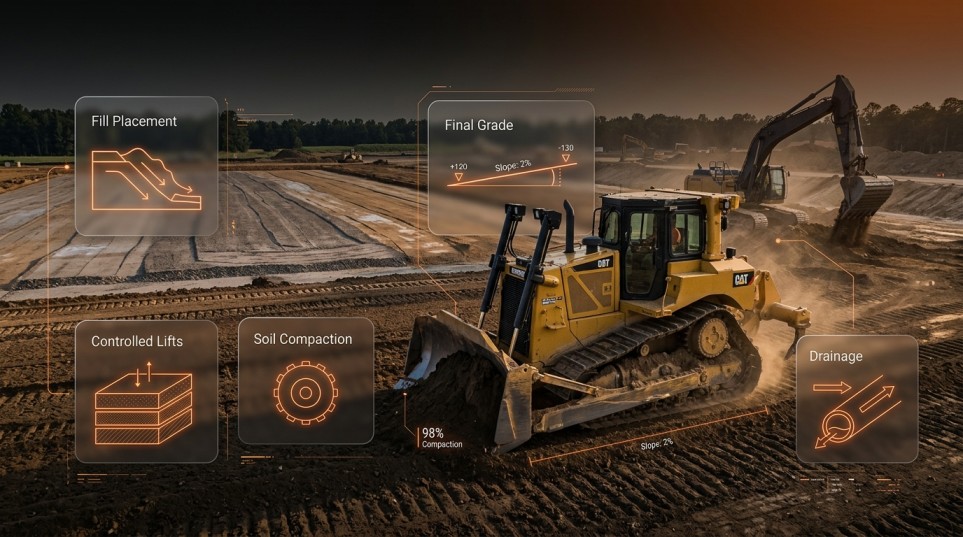
Most driveway failures that show up in the first few years trace back to this stage. Not every project needs every step below, but the sequence is the same: get down to material that can support the pavement, build the layers back up, and control moisture along the way.
Removing Existing Pavement and Excavating to Depth
On a replacement, existing pavement is broken out and removed rather than buried, and the excavation continues to the depth the new section requires. Depth is not a fixed number. It comes from the planned pavement and base thicknesses plus whatever has to be removed because it will not support load.
Old gravel that has been contaminated with clay is a common surprise. It may look like base material and behave like soil. The same is true of fill placed during original construction, buried organic material near tree lines, and utility trench backfill that was never compacted.
Stabilizing Soft Subgrade
When the exposed subgrade is soft, wet, or pumping under equipment, paving over it does not solve anything. Common approaches include undercutting the soft material and replacing it with suitable aggregate, adding a geotextile separation layer to keep base and soil from mixing, improving drainage so the area is not being fed water, or using a designed chemical stabilization treatment where the project warrants it and a design supports it.
Which of those applies depends on how deep the problem goes and why the area is soft. Site work and grading are part of what a full-service contractor handles, and the asphalt paving scope on a rebuild often includes the dirt work needed to get there.
Installing and Compacting the Aggregate Base
Aggregate base is placed and compacted in lifts rather than dumped to full depth in one pass, and moisture content affects how well it densifies. The finished base is shaped to the planned grade and slope, because the surface will follow whatever shape the base is left in. A low spot in the base becomes a low spot in the driveway.
One caution about numbers you may see in proposals: compaction percentages for soil and aggregate are measured against a laboratory reference, while asphalt density is measured differently. They are not the same figure, and a percentage quoted without a governing specification and test method does not tell you much.
Driveway Slope and Drainage
Establishing Proper Slope for Runoff
A paved driveway needs enough slope for water to leave the surface, and it needs that slope pointed somewhere useful. Designers commonly target a cross slope in the range of about 1 to 2 percent on hard-surfaced areas so that water sheds rather than ponds, but the right slope for your driveway depends on the layout, the elevations you have to work with, where the water can legally go, and any local requirement. There is no single correct number for every driveway.
The constraints usually come from the fixed points: the garage floor or slab elevation, the road elevation at the connection, and the ground in between. Where those points do not leave enough fall, the answer is usually a drainage feature rather than a steeper surface.
Preventing Standing Water and Erosion
Standing water is worth taking seriously, but a single puddle does not prove a failed design. It might reflect a local low area, settlement over a trench, a blocked outlet, or a change in the surrounding grade since the driveway was built. Careful grading and drainage planning can help direct surface water appropriately; no paving treatment by itself guarantees that water will never stand anywhere on the surface.
Erosion tends to show up at the unsupported edges, where runoff leaves the pavement and cuts into soil. Shoulder material, edge grading, and controlling where concentrated flow lands, including roof downspouts, do more for edge life than surface treatments do.
Tying Driveway Drainage Into Culverts and Ditches
Where the driveway meets a ditch, the driveway becomes part of the drainage system. The culvert has to sit at the right elevation to carry the ditch flow, the ends need to be kept clear, and the driveway surface should not divert water onto the roadway. Agencies pay attention to this because a driveway that impedes ditch flow moves the problem to a neighbor or to the road itself.
For paved areas that shed toward the house rather than the street, the drainage plan may need a swale, a trench drain, or a piped outlet. Those items belong in the scope and the estimate, not in a conversation after the base is graded.
The Driveway Paving Process
Excavation, Grading, and Base Installation
The project starts with layout and utility locates, then removal, excavation, and shaping of the subgrade. The base is placed and compacted in lifts to the planned grade. On most residential projects, this stage takes longer than the paving itself, and it is the stage where changes in scope, such as an unexpected soft area, usually surface.
Applying Asphalt, Concrete, or Pavers
For asphalt, the mix is delivered hot, placed with a paver or by hand in constrained areas, and rolled while it is still workable. Where new asphalt is being placed over an existing bound surface, a tack coat is used to help the layers bond. Thicker sections are usually placed in more than one lift, with attention to joints between passes.
For concrete, forms are set to the planned grade, the mix is placed and consolidated, the surface is finished, and joints are cut or tooled to control where shrinkage cracking occurs. Widely used residential guidance ties joint spacing and joint depth to slab thickness rather than treating them as fixed dimensions. Curing then protects the slab while it gains strength.
For pavers, a bedding layer is screeded over the compacted base, units are laid to the chosen pattern, edge restraints are installed, and joint sand is swept in and compacted. The edge restraint is not optional. It is what keeps the field of units from spreading.
Compaction, Finishing, and Curing
Compaction is where asphalt quality is won or lost, and it depends on the mix, the temperature of the mat, lift thickness, roller type, and the rolling pattern. More rolling is not automatically better; rolling at the wrong time or with the wrong equipment causes its own problems. Any density figure in a proposal should be tied to a specification and a test method, or it is decoration.
Concrete is not finished when it looks finished. Curing continues after the crew leaves, and the slab keeps gaining strength for weeks. Asphalt does not cure in the same sense, but it does continue to stiffen as it cools and ages, which is why a fresh surface behaves differently in the first weeks.
When You Can Drive on It
Follow the instructions your contractor gives for your project, because conditions vary. As general context: new asphalt needs to cool before it carries vehicles, and hot weather, thicker sections, and shaded areas all extend that time. New concrete needs curing time before vehicle loads, and residential guidance commonly points to about a week before driving on a new slab, longer for heavier vehicles. Pavers are generally usable once the units are compacted, jointed, and restrained.
For the first several weeks on new asphalt, a few habits protect the surface: avoid turning the steering wheel while stopped, keep trailer jacks and kickstands on a spreader plate, and avoid parking a heavy vehicle in the same spot on the hottest afternoons.
Best Time of Year to Pave in Louisiana
How Temperature and Rain Affect Installation
Louisiana has a long working season compared with northern markets, so rain is usually the binding constraint rather than cold. Precipitation is spread throughout the year here, and a wet subgrade or a wet base can delay a project that had a perfect forecast on paper.
Cold still matters at the margins. The National Asphalt Pavement Association has defined cold-weather paving as placing and compacting asphalt when either the air or the base temperature is below 50 degrees F, and the practical issue is the compaction window: the mat cools faster in cold, wind, and on cold surfaces, and thinner lifts cool fastest of all. That is why lift thickness, mix temperature, haul time, and roller coverage all get planned together rather than one at a time. Summer brings its own considerations, since a very hot surface changes how quickly a mat can be worked and how soon it can carry traffic.
When to Reschedule a Paving Project
Rescheduling is not a red flag. It is usually a contractor protecting your driveway. Common reasons to move a date include rain in the forecast during placement or before the surface is set, a subgrade or base that is saturated from earlier rain, temperatures that make the compaction window impractical for the planned section, and permit or culvert work that has not been inspected yet.
If you are working around an event or a delivery, build slack into the schedule. A driveway placed in poor conditions to hit a date is a repair conversation later.
Maintaining Your Driveway
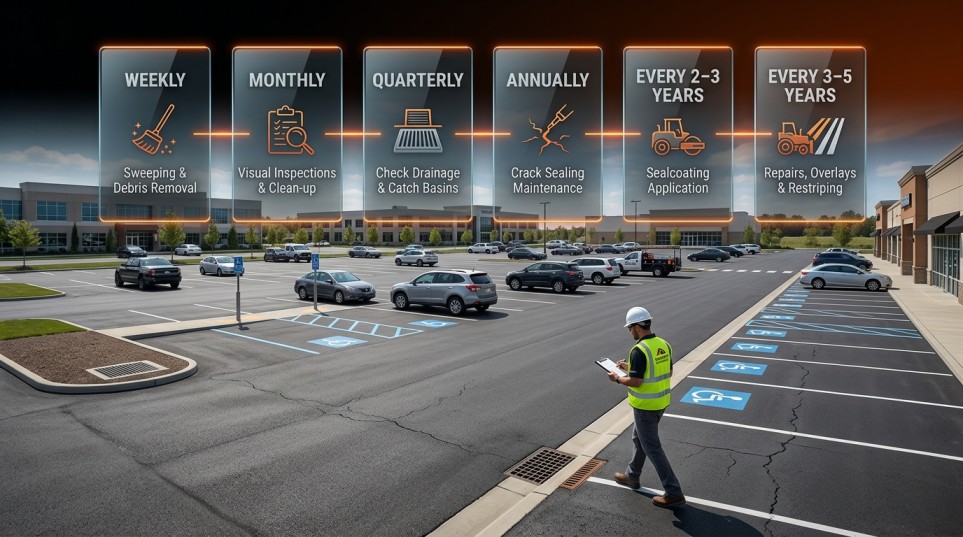
Maintenance by Material (Quick Reference)
| Task |
Asphalt |
Concrete |
Pavers |
| Routine |
Sweep debris, keep edges supported, watch for low spots |
Sweep and rinse; clean oil promptly |
Sweep; keep joints filled; control weeds and ant hills |
| Cracks and joints |
Seal working cracks before water reaches the base |
Reseal joints as sealant ages or fails |
Refill joint sand where it has washed or blown out |
| Surface treatment |
Periodic seal coating on a cycle set by condition and exposure |
Optional surface sealer depending on finish and preference |
Optional joint stabilizing sealer per the product used |
| Drainage |
Keep edges, ditch, and culvert ends clear |
Same, plus keep joints at the apron clear |
Same, plus check for settled units near outlets |
| Watch for |
Raveling, edge breakup, wheel-path cracking, soft areas |
Cracks crossing panels, offsets at joints, spalling |
Rutting, spreading edges, sunken units |
Sealcoating and Crack Repair
Seal coating is a surface maintenance treatment for asphalt. It addresses the surface: oxidation, minor surface wear, appearance, and resistance to some spills. It is not a structural repair. It does not fix potholes, restore a failed base, correct interconnected fatigue cracking, or add load-carrying capacity. Any material that claims to do those things on a driveway that is failing structurally is being oversold.
Timing matters on new pavement. Industry practice is to let new asphalt cure before the first application, and commonly cited guidance points to roughly six to twelve months, with the exact timing depending on conditions, exposure, and the sealer product used. Confirm timing with your contractor and the product data rather than sealing a fresh driveway on impulse.
Crack work comes first, since sealer is a coating and not a filler. Crack and joint sealing addresses working cracks that let water reach the base, and it is worth doing early, while cracks are still narrow and isolated. Where cracking is widespread and interconnected, sealing individual cracks is no longer the right conversation. That pattern points toward evaluating the structure. Seal coating is then applied to a surface that has already been repaired.
Keeping Drainage Clear
The cheapest maintenance on a Louisiana driveway is usually drainage maintenance. Keep the ditch flowing, keep culvert ends free of silt and vegetation, keep downspout discharge away from pavement edges, and watch for grade changes from new landscaping, fences, or neighboring construction that redirect water toward your driveway.
Common Driveway Problems and What They Mean
Distress is what you can see. Cause is what you have to establish. The two are related but not the same, and the same visible symptom can have several contributing causes.
Cracks, Potholes, and Surface Deterioration
Individual straight cracks in an otherwise sound asphalt surface are often surface-level and are candidates for sealing. Interconnected cracking in the wheel paths that resembles the pattern on an alligator hide is a different signal, commonly associated with fatigue under load, and it raises questions about the structure and about water. Raveling, where the surface loses aggregate and turns rough, is a surface condition that can come from mix, age, or construction factors.
A pothole is a hole, not a diagnosis. It tells you that material was lost at that spot, usually with water involved, and it does not tell you whether the base is sound. A temporary patch is exactly that. If the same spot fails repeatedly, the patch is not the problem.
Settling, Base Failure, and Water Pooling
Localized settlement often lines up with something specific: a utility trench, a former stump hole, fill placed during construction, or an area that stays wet. Broad settlement over a larger area points more toward the subgrade or the base. Pooling in a settled area is a symptom of both the elevation change and whatever caused it.
Whether that requires patching, partial reconstruction, or regrading depends on how deep the problem goes, how large the area is, and whether the water source has been dealt with. That determination needs someone to look at the site.
Tree Root and Soil Movement Damage
Large trees near a driveway affect pavement in two ways. Roots can lift and crack the surface directly, and root systems also draw moisture from the soil, which contributes to shrinkage in clay soils during dry stretches. Damage that appears near a mature tree during a dry summer and partially closes afterward is usually telling you about moisture rather than about the asphalt.
Solutions range from root pruning with an arborist involved, to root barriers, to rebuilding the affected section, to accepting some movement in exchange for keeping the tree. Removing a mature tree has its own consequences for soil moisture, so it is not automatically the fix.
Repair or Replace?
Age alone does not answer this. What matters is the type, severity, and extent of the distress, the condition of the base and subgrade, whether drainage has been addressed, the elevation constraints at the garage and the road, and how you intend to use the driveway.
- Localized repair fits when deterioration is limited, and the surrounding structure is still supporting the load.
- An overlay or resurfacing can restore the surface where the structure below is sound. It does not repair a failed base, correct widespread fatigue cracking, or solve a drainage problem, and it raises the surface elevation, which has to work at the garage, the apron, and the edges.
- Reconstruction is considered when the structure itself is no longer adequate, when grades have to change, or when repeated repairs have stopped holding.
A contractor should be able to explain which factors point which way on your driveway, and what they would need to open up or verify to be confident.
Mistakes That Ruin a New Driveway
Skipping Base Preparation or Using Wrong Thickness
This is the most expensive shortcut available, because it is invisible on the day the job finishes and undeniable two years later. Good surface material placed over a weak or contaminated base does not compensate for the base. Neither does an extra half inch of surface. When comparing bids, treat a proposal that specifies excavation depth, base material, compacted base thickness, and surface thickness as more informative than one that lists a price and a square footage.
Ignoring Drainage and Culvert Requirements
Driveways that trap water, block a ditch, or discharge across a roadway create maintenance problems and sometimes regulatory ones. Culvert size and grade are determined by the agency with jurisdiction, and a driveway built over an undersized or misgraded pipe usually has to be opened back up. Handle the drainage design and the permit before the surface goes down.
Driving on It Too Soon
New pavement is at its most vulnerable in its first days and weeks. On asphalt, early traffic and sharp turning while stopped leave scuffs and depressions that do not heal. On concrete, early vehicle loads can crack a slab that has not gained strength. On pavers, traffic before joints are filled and edges are restrained lets units shift. Ask for the specific timeline for your project and treat it as part of the work rather than a suggestion.
FAQ
How Thick Should a Residential Driveway Be?
There is no single correct thickness. Asphalt industry guidance for residential drives describes ranges, such as roughly 4 to 6 inches for full-depth asphalt on a prepared subgrade or a thinner asphalt section over several inches of compacted aggregate, while residential concrete slabs commonly start around 4 inches with more where loads or local requirements justify it. The section that fits your driveway depends on subgrade support, drainage, and your heaviest realistic loads. Also confirm whether a quoted asphalt thickness is loose or compacted.
How Long Before You Can Drive on a New Driveway?
Follow the contractor's instructions for your specific project. New asphalt has to cool before it carries vehicles, and heat, section thickness, and shade all affect that. New concrete needs curing time before vehicle loads, with residential guidance commonly pointing to about a week and longer for heavy vehicles. Pavers are generally usable once compacted, jointed, and edge-restrained.
Do You Need a Permit to Pave a Driveway in Louisiana?
It depends on the road and the jurisdiction. A connection to a state highway requires a DOTD access connection permit. Parish and city roads follow parish or municipal requirements, which commonly apply to new driveways, widening, relocation, and culvert work inside the right-of-way. Resurfacing in place sometimes requires nothing. Confirm with the agency that maintains your road before work is scheduled.
Do You Need a Culvert for a Residential Driveway?
You need one when the driveway crosses a roadside ditch or drainage path that has to keep flowing under it. Louisiana parish policies commonly have the road superintendent or designee determine the location, the correct pipe size, and the required grades, and an application may be denied where a properly sized culvert cannot be set on grade without impeding drainage. Do not let pipe size be chosen by convenience.
What's the Best Time of Year to Pave in Louisiana?
There is no single best month here. The season is long because winters are mild, so scheduling usually turns on rainfall and site conditions rather than the calendar. Dry stretches with moderate temperatures make the work easier, and cold snaps matter mainly because they shorten the compaction window, which the industry associates with air or base temperatures below 50 degrees F. Plan for weather delays instead of a perfect week.
Conclusion
A driveway that lasts is mostly the result of decisions made before any surface material arrives. Match the material to how you actually use the driveway. Build the section on ground that can support it. Plan where water goes, at the surface, at the edges, and at the road. Handle the permit and the culvert with the agency that maintains your road. Then compare proposals on scope rather than on a single number.
If you are planning a new driveway, weighing repair against replacement, or trying to make sense of quotes that do not match, have the site looked at first. Precision Blacktopping LLC handles residential driveway paving, resurfacing, repair, and site work for property owners across Louisiana, Mississippi, and Texas, from its home base in Pineville. Call (318) 955-3100 or request a free estimate or on-site assessment to talk through the right solution for your property.
.png)