
September 16, 2026
A parking lot maintenance program is a written, repeating plan for inspecting, cleaning, repairing, sealing, and restriping a paved lot. It replaces reaction with scheduled work tied to actual pavement condition. The right intervals depend on traffic, pavement age, drainage, and the distress already present. No online guide can set your schedule, so an on-site assessment should confirm what your lot needs.
Most parking lots do not fail suddenly. They lose a little ground each season, and the cost of catching up grows quietly along with it. A crack that admitted water last spring becomes a soft spot this summer, then a pothole that a delivery driver reports in the fall.
This guide covers what a real maintenance program contains, how to read your own pavement, how often work should happen, and when maintenance stops being the answer. It is written for property owners, facility managers, and business owners responsible for commercial lots in Central Louisiana and the surrounding Gulf South.
A maintenance program is a plan, not a service. It documents what pavement you own, what condition it is in, what gets checked and when, what triggers a repair, and what you expect to spend each year. Contractors carry out the work. The program is what tells you which work to buy and in what order.
A workable program usually contains five pieces:
Without the record-keeping piece, a program is really just a list of good intentions. The record is what lets you see whether a section is holding steady or sliding.
Reactive repair means fixing pavement after it fails or after someone complains. It feels efficient because nothing is spent until something breaks. The trade-off is that failures usually announce themselves at the worst moment, often after rain, and the repair scope is already larger than it would have been.
Preventive maintenance means applying planned treatments while the pavement is still in reasonable condition. The FHWA describes pavement preservation as planned work that improves or sustains a facility in a state of good repair, and notes that preservation activities generally do not add structural value. That last part matters. Preservation protects what you already have. It does not rebuild a pavement that has already lost its structure.
Highway agencies moved toward preservation because treating pavement while it is still in satisfactory condition can slow deterioration at relatively low cost. FHWA guidance frames the goal as applying the right treatment at the right time on the right project. Applied too early, a treatment wastes money. Applied too late, it sits on pavement that needed something heavier.
You will find ratios online claiming that every dollar spent on maintenance saves a specific number of dollars later. Treat those with care. They come from network-level agency modeling across hundreds of road miles, not from a single commercial lot, and they cannot be transferred to your property as a promise.
The defensible version is simpler. Water entering through an unsealed crack can reach the base and subgrade, and pavement that loses support underneath does not get better on its own. Sealing that crack is a small job. Rebuilding the area it damaged is not. The savings are real in principle, but the amount is site-specific.
An asphalt lot is a layered system. Below the surface course sits asphalt binder layers, an aggregate base, and the subgrade soil that supports everything above it. Drainage, curbs, and edges are part of that system too. What you see from the parking stall is the top of it, not the whole of it.
This is why a good-looking surface is not proof of a sound pavement, and why a rough-looking one is not proof of failure. The visible condition is evidence. It is not a diagnosis.
Water is the factor most often underestimated. It enters at cracks, joints, edges, and around structures such as inlets and manholes. Once it reaches the base or subgrade, it can reduce the support those layers provide. Loading then does more damage than it otherwise would.
Traffic loading is uneven across a lot. Passenger vehicles in stall rows apply far less load than delivery trucks turning near a loading dock, garbage trucks setting down on a dumpster pad, or vehicles queueing in a drive-through lane. Those areas often show distress years ahead of the rest of the lot.
Heat and ultraviolet exposure age the asphalt binder over time. An aged, oxidized surface tends to become more brittle, which can show up as raveling, a dry appearance, or block cracking. Unshaded lots take more of this than lots with tree cover or building shadow.
Petroleum products soften asphalt binder. Motor oil, diesel, and hydraulic fluid can leave localized soft spots, most commonly under parked equipment, near fuel islands, and in loading areas. Those spots often need repair rather than a surface treatment.
The single most useful distinction in pavement maintenance is between distress that lives in the surface and distress that reflects the layers below.
Surface-level indicators include raveling, a dry oxidized look, faded markings, and isolated cracks that are not part of a connected pattern. These often respond well to preservation treatments if caught while the pavement is otherwise sound.
Structural indicators include interconnected fatigue cracking in a loaded area, rutting along wheel paths, depressions that hold water, potholes that reopen, and patches that fail within a season. Fatigue cracking is commonly associated with load and support problems, but severity, extent, and site conditions all have to be evaluated before anyone can say what is happening underneath.
Applying a surface treatment to structural distress is the most expensive mistake in this category. The lot looks better for a while, and the underlying problem keeps moving.
You do not need engineering training to run a useful inspection. You need a consistent route, a camera, and a habit of writing down what you saw and when. Formal condition surveys for roads and parking lots follow ASTM D6433, the standard practice for Pavement Condition Index surveys, but your own walk-through does not have to be that rigorous to be valuable.
Walk the lot when traffic is light, wear high-visibility clothing, and stay out of any area where a contractor is actively working. Work zones with moving equipment carry serious struck-by hazards and are not places to inspect pavement.
Note and photograph the following:
Photograph from the same positions each time and date the files. A year of consistent photos tells you far more about rate of change than a single detailed inspection ever will.
Louisiana is a wet state. NOAA’s state climate summary puts annual precipitation at roughly 50 inches in the north and up to about 70 inches at some southeastern locations, with rain distributed across the year rather than concentrated in one season. Central Louisiana sits within that range, and the practical effect on pavement is repeated wetting rather than occasional soaking.
That shifts where the risk sits. Freeze-thaw cycling is a limited factor here compared with northern states. Water management is the dominant one. A lot that drains well and sheds water quickly is working with the climate. A lot with flat spots, blocked inlets, or a low area near a building is not.
Long hot summers add the second local factor. Sustained heat and sun exposure accelerate binder oxidation on unshaded pavement, and hot pavement is softer under standing loads such as trailer jacks and dumpster wheels. Neither effect ruins a lot on its own. Both make a maintenance schedule worth keeping.
The services below are the standard components. Not every lot needs every item every year, and the sequence matters as much as the list. Repairs generally come before surface treatments, and drainage problems generally come before both. Precision Blacktopping provides these as part of its parking lot maintenance services across Louisiana, Mississippi, and Texas.
Sweeping removes grit, sand, leaves, and litter before they collect in low spots and around inlets. Organic debris packed into a crack holds moisture against the pavement and makes later sealing harder, because sealant needs a clean, dry crack to bond properly. Sweeping also keeps drainage structures from silting up quietly over a season.
Pair sweeping with the inspection routine. The person on the lot most often is usually the one who notices a new pothole first, and a short monthly note from them is worth more than an elaborate annual report nobody reads.
Crack treatment exists to keep water out. The terminology matters when the distinction affects the work. Crack sealing typically uses a flexible sealant on cracks that move with temperature, which is why the material has to stretch. Crack filling generally addresses cracks with little movement and uses different material expectations.
Crack treatment works on isolated, defined cracks in pavement that is otherwise sound. It is not a treatment for widespread fatigue cracking, and it does not repair a base problem. When cracking has become an interconnected pattern across a loaded area, the question has changed from sealing to repair.
Sealcoating is a surface treatment applied over structurally sound asphalt. It provides a wearing surface that takes oxidation and minor spillage instead of the pavement itself, and it restores a uniform appearance that makes fresh striping read clearly.
It is worth being blunt about the limits, because sealcoat is the most oversold product in this industry. Sealcoating does not repair potholes. It does not fix alligator cracking. It does not restore structural capacity, and it is not permanent waterproofing. Reapplication timing depends on the product used, traffic volume, and the condition of the surface underneath.
A lot that needs repairs and a sealcoat should get the repairs first. A lot that needs structural work does not need a sealcoat at all yet.
Patching is not one thing. The options differ in depth and in what they are expected to accomplish:
Temporary material is a stopgap. It has a place, particularly when a hazard appears on a Friday and the crew is booked, but it should be logged as temporary so it does not quietly become the permanent solution.
When potholes keep coming back in the same location, or patches fail within a season, the repair itself is usually not the problem. Water, base condition, patch preparation, or loading in that specific area are the things worth investigating. That investigation needs a site visit, not a guess from a photo.
Markings do more than tidy the lot. They set parking capacity, organize circulation, define fire lanes and loading zones, direct traffic at entrances, and identify accessible parking and its access aisles. Faded markings degrade all of that at once.
For accessible spaces, note that the ADA Standards do not specify marking color or method. The U.S. Access Board’s technical guide on parking spaces explains that both the space and the access aisle must be marked, that the marking method and color are addressed by state or local codes rather than the federal standard, and that width is measured to the centerline of markings. Check local requirements before finalizing a layout.
Drainage work in a maintenance program is mostly about keeping the designed system functioning. That means clearing inlet grates and catch basins, keeping curb lines and gutter pans free of debris, checking that outfalls are not blocked, and looking at the lot during rain rather than only after it.
Where water stands repeatedly in the same place, cleaning may not be the answer. Persistent ponding can involve grade, settlement, base condition, or a structure issue, and correcting it can mean grading or drainage work rather than a surface treatment. Proper grading and drainage planning can help direct surface water appropriately, but no paving treatment should be sold as a guarantee against standing water.
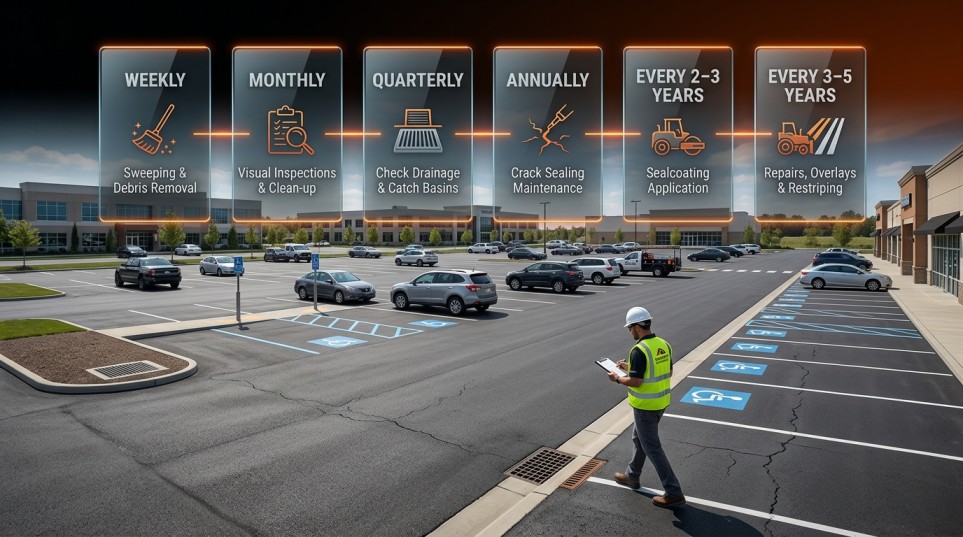
The schedule below is a planning framework for a typical commercial lot. Treat the intervals as starting points for budgeting, not as specifications. Actual timing should follow pavement condition, traffic, and what your annual assessment finds.
The two longer intervals deserve a caveat. Sealcoat and crack seal cycles are commonly discussed in these ranges, but they are industry planning conventions rather than engineering requirements. A high-traffic lot may need attention sooner. A lightly used lot in good condition may not benefit from a treatment applied on schedule if the pavement does not call for it yet.
Treat the lot as zones, not as one surface. A retail lot might have a delivery route and dumpster approach carrying heavy loads daily, main drive lanes carrying constant passenger traffic, and back rows that see a car a week. Inspecting and treating all three on the same cycle wastes money on one end and under-serves the other.
Practical zoning factors include daily vehicle counts, the presence of trucks or equipment, turning and braking areas, standing loads such as trailers and containers, drive-through queueing, and any area that stays wet longer than the rest of the lot.
New pavement mostly needs protection and observation. Keep it swept, keep drainage clear, keep markings legible, and watch areas around utility cuts and structures for early settlement. There is usually little to repair, and treatments applied too early add cost without adding benefit.
Mid-life pavement is where a program earns its keep. Cracks appear and start to work. Crack sealing becomes a recurring line item. Sealcoat decisions come into play where the surface is sound. Localized patching handles the first isolated failures, typically in the loaded zones.
Aging pavement changes the question. The assessment stops being about which preservation treatment to apply and starts being about whether preservation still returns value, or whether resurfacing or reconstruction is the honest answer. A contractor who keeps selling sealcoat at this stage is not doing you a favor.
This decision should never rest on pavement age alone. The factors that actually matter are the type of distress, its severity, how much of the lot it covers, the condition of the base and subgrade, how the lot drains, traffic and loading, how previous repairs have performed, and any constraints on elevation at curbs, doorways, and drainage structures.
A guide can tell you what gets evaluated. It cannot select your treatment. That requires someone on the property looking at the pavement.
Localized repair tends to be appropriate when distress is limited in extent, the surrounding pavement is sound, drainage is functioning, and the failures are not repeating in the same spots. In that situation, repairing the defined areas and continuing the preservation cycle is usually the reasonable path.
The caution is scope creep in reverse. Patching a growing number of areas each year while the total keeps climbing is a signal, not a strategy.
An asphalt overlay places new asphalt over the existing pavement. It can make sense when surface distress is widespread, but the underlying structure is largely intact, and when elevations can accommodate the added thickness.
What an overlay does not do is worth stating plainly. It does not automatically fix a failed base, severe fatigue cracking, poor drainage, or elevation problems. Distress in the layers below can reflect back through a new surface, sometimes within a short period. Areas of structural failure are generally repaired before an overlay goes down, not covered by it.
Milling is often part of resurfacing work. It can remove deteriorated surface material, manage elevations at curbs, gutters, and door thresholds, and restore an appropriate profile before new asphalt is placed. Milling depth is a project decision based on existing conditions and the target elevation. There is no single depth that applies to every lot, and milling does not by itself correct deeper structural problems.
Reconstruction removes the existing pavement and rebuilds the section, which can include work to the base and subgrade. It comes into consideration when structural failure is widespread rather than localized, when repairs and patches keep failing, when the base or subgrade condition is understood to be inadequate, or when grade and drainage corrections cannot be achieved any other way.
Reconstruction should not be recommended simply because a lot looks old or because the surface is unattractive. Appearance and structure are different questions, and the more expensive answer needs the stronger justification.
A few patterns tend to mark the transition:
None of these confirms on its own that reconstruction is required. Together, they justify a professional assessment rather than another round of the same treatments.
This section is about risk you can see and reduce. It is general information about pavement condition and accessibility standards, not legal advice, and it does not determine the compliance status of any specific property.
The pavement defects that matter most for pedestrian safety are usually the ones property owners notice least. Vertical separations at patch edges, settled areas around utility structures, broken curb ramps, deteriorated pavement at building entrances, and displaced wheel stops all sit directly in walking routes.
Prioritize by where people walk, not by how bad the pavement looks. A large pothole in a back corner of a truck route is a maintenance item. A two-inch lip across the route from an accessible space to the front door is a safety item, and it should be handled first.
Where a repair cannot be scheduled immediately, interim measures such as cones or barricades keep the hazard visible while the work is arranged. Log the date the hazard was found, the interim measure used, and the date of the permanent repair.
Accessible parking is governed by the 2010 ADA Standards for Accessible Design. The Department of Justice has addressed the maintenance case directly. Its compliance brief on restriping parking spaces states that when a business or government entity restripes parking spaces, it must provide accessible parking spaces as required by the 2010 Standards. Businesses serving the public also have a continuing obligation to remove access barriers where doing so is readily achievable, and the brief notes that restriping is inexpensive enough to be readily achievable in most cases.
The core requirements property owners most often need to check:
Two practical points follow from this. First, the slope requirement cannot be met with paint. If a space or aisle exceeds the maximum slope, correcting it is grading work, and restriping over it does not resolve the issue. Second, the ADA.gov parking topic page notes that hospital outpatient, rehabilitation, and similar facilities carry different and higher scoping requirements, so a medical property should not use the general table.
State and local codes can add requirements beyond the federal minimums, including marking color and signage details. A guide cannot certify that any lot meets the standards. That determination requires a project-specific evaluation on the property.
Records are the least expensive part of a maintenance program, and the part most often skipped. Keep dated photos from consistent vantage points, written inspection notes, work orders, contractor invoices with scope described, and a marked lot map showing repair locations and dates.
The practical value shows up in three places. Budgeting becomes evidence-based instead of reactive. Bid comparison becomes possible because you know what was actually done last time. And if a condition is ever questioned, you have a record of when it was identified and what was done about it.
Pavement work is priced from scope and site conditions, so any number published on a website is a guess about someone else’s lot. What follows is the structure of the cost, which is portable, rather than figures, which are not.
The variables that move a parking lot maintenance number most:
When comparing proposals, compare scope before price. A lower square-foot figure may reflect a thinner repair scope, less preparation, different materials, or fewer repair areas. Ask each contractor to describe repair depth, quantities, preparation, and exclusions in the same terms, then compare like with like.
It helps to sort spending into two categories that behave differently. Recurring upkeep is small, predictable, and annual: sweeping, inspections, drainage cleaning, spot repairs, and periodic marking work. Periodic capital work is larger and episodic: sealcoating cycles, significant patching campaigns, resurfacing, and reconstruction.
The reason agencies invest in the first category is that timely, lower-cost treatment on pavement in reasonable condition can delay the second category. That is the logic behind FHWA’s preservation program, and it holds up in principle. What it does not do is produce a fixed savings figure for your property. The benefit depends on your pavement, your traffic, your drainage, and whether treatments are applied at the right time.
A workable budget follows the assessment rather than preceding it. The sequence that tends to work:
If you are building a maintenance budget for a commercial property in Central Louisiana, Precision Blacktopping offers a free estimate and an on-site assessment. Having someone walk the lot and describe what they see in writing is the difference between a budget built on scope and a budget built on assumptions.
The two surfaces do not fail the same way, so they are not maintained the same way. Asphalt is a flexible pavement, and its maintenance centers on keeping water out and the surface intact through crack treatment, surface treatments, patching, and eventually resurfacing. Repairs generally blend into the surrounding pavement, and treatment options are relatively plentiful.
Concrete is rigid. Maintenance focuses on joint sealing, spall and crack repair, and eventually replacing individual panels. Repairs are more visible, and the unit of work is often a slab rather than an area. Localized repair on concrete tends to be more involved than on asphalt, though the surface generally needs less frequent routine attention.
Neither material is universally cheaper, stronger, or lower-maintenance. The appropriate choice depends on loading and traffic type, subgrade and site conditions, drainage, construction schedule and access constraints, expected service life, repairability, and budget. Many commercial properties end up mixed, using concrete at dumpster pads and truck aprons where standing loads concentrate and asphalt across drive lanes and parking areas. Precision Blacktopping performs both asphalt and concrete paving, so the comparison can be made against your actual site rather than against a preferred product.
Deferral is the most common and the most expensive habit. An open crack admits water. Water reaching the base can reduce the support beneath the surface. Reduced support under traffic produces the failures that eventually get called potholes.
The trap is that deferral rarely looks like a decision. It looks like a busy quarter, a tight budget, and a repair that can wait until next season. It can wait, and the scope grows while it does.
Drainage gets overlooked because it is invisible when the weather is dry. Blocked inlets, silted catch basins, debris in gutter pans, and low areas that hold water are all easy to miss on a sunny inspection. Walk the lot during rain at least a few times a year. Fifteen minutes in the wet tells you more than an hour in the dry.
Ignoring drainage also undermines everything else you spend. Repairs placed in a chronically wet area tend to fail early, and a surface treatment over a drainage problem is money applied to the wrong layer.
Mismatched treatment wastes budget and delays the real fix. The recurring versions:
The common thread is applying a treatment because it is affordable and available rather than because the pavement condition calls for it. Matching treatment to condition is the entire discipline.
A full program typically includes routine sweeping and debris removal, documented inspections, crack sealing, pothole and surface repairs, drainage maintenance, striping and accessible markings, and sealcoating where the pavement is sound. Larger items such as resurfacing enter the plan when condition assessments indicate that preservation alone is no longer appropriate.
A practical pattern is a short monthly visual check by on-site staff, a quarterly drainage and markings review timed near heavy rain, and one documented annual assessment with a paving professional. High-traffic lots, lots with heavy delivery activity, and lots with a history of drainage issues generally warrant more frequent attention.
There is no single service life that applies to every lot, and any specific number quoted without site information is not meaningful. Service life depends on the original design and construction quality, base and subgrade condition, drainage, traffic and loading, materials, climate exposure, and how consistently the pavement has been maintained. Two lots built in the same year on the same street can be in very different condition a decade later.
It depends on how much of the lot is affected and whether the distress is structural. Localized distress in otherwise sound pavement usually points toward repair. Widespread structural failure, repeatedly failing patches, or drainage and grade problems that cannot be corrected at the surface point toward more extensive work. That assessment requires someone evaluating the pavement on site, not a determination made from a description or a photo.
Cost is driven by lot size, current condition, the quantity and depth of repairs, surface preparation, drainage and accessibility work, striping complexity, phasing around business operations, and site access. Because those vary so widely, a published figure would not tell you anything useful about your property. A scope-based estimate following a site visit is the only reliable number.
A parking lot maintenance program is mostly a discipline of sequence. Establish what condition the pavement is actually in. Address safety and accessibility first, then drainage, then repairs, then surface treatments. Record what you find and what you do, so next year’s decisions rest on evidence rather than memory.
The two ideas worth carrying forward are these. Condition should drive treatment rather than the calendar, and surface treatments protect a pavement without rebuilding one. Programs go wrong when those get reversed, and the reversal is usually invisible until the repair bill arrives.
If your lot is due for an assessment, or you are deciding between another round of repairs and something more substantial, Precision Blacktopping LLC provides a free estimate and on-site assessment for commercial and residential properties across Louisiana, Mississippi, and Texas, with Pineville and the Alexandria area as its home market. Call to talk through what your pavement is showing and what the appropriate next step looks like for your property.
.png)