
September 16, 2026
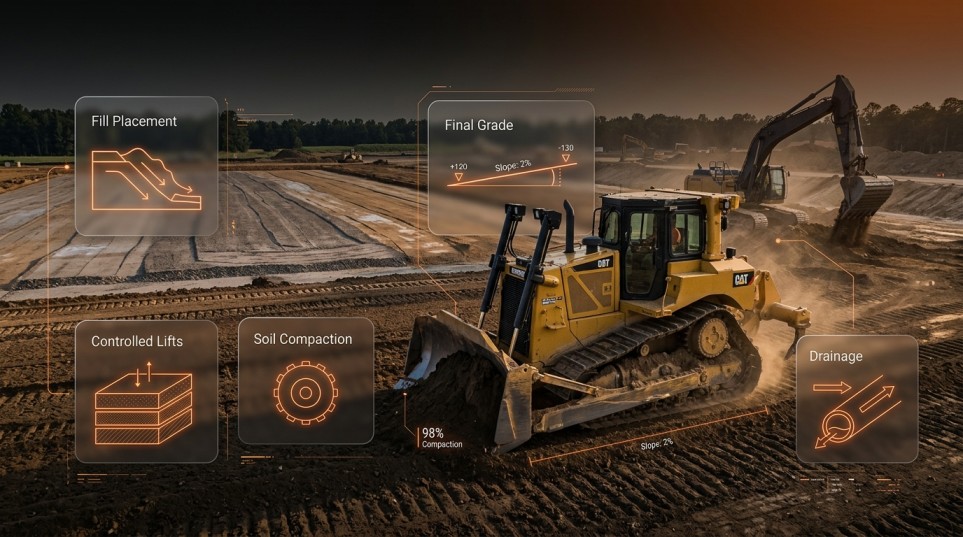
Dirt work and site grading are the earthwork steps that shape, level, and compact ground before anything is built on it. In Central Louisiana, that usually means clearing, cut and fill, placing fill in compacted lifts, and setting final grades so water moves away from structures. Scope, cost, and schedule depend on soil, elevation, access, and drainage, which a contractor confirms during a site visit.
Dirt work is the broad term for moving soil on a property. It covers clearing, excavation, hauling, filling, shaping, and compaction. Site grading is the part of that work that sets the finished elevations and slopes of the ground surface.
Both happen before the visible parts of a project begin. A slab, a driveway, a parking lot, or a metal building sits on whatever the earthwork left behind. That is why site preparation tends to control how the finished project performs and how long it stays that way.
These three terms get used interchangeably in conversation, but they describe different activities. The difference matters most when you are reading a proposal.
A bid for grading only may not include importing fill, hauling off spoil, or removing stumps. Those line items can move a price considerably, so confirm which of the three you are actually buying.
Anything built on the ground depends on the material beneath it for support. A concrete slab, an asphalt driveway, and a gravel lot all transfer load down into the subgrade. When the subgrade is soft, wet, uneven, or poorly compacted, the surface above it tends to show it eventually.
This is the part property owners are most often surprised by. A well-built surface cannot make up for a poorly prepared site. Quality asphalt placed over an unstable subgrade is still asphalt sitting on an unstable subgrade, and the same holds true for concrete.
Site preparation also locks in drainage. Once a slab is poured or a lot is paved, elevations become difficult and expensive to change. Fixing the grade afterward usually means removing and rebuilding whatever is on top of it.
Dirt work covers a wide range of project types across residential and commercial properties. The table below groups the most common ones by what the work generally involves.
These scope descriptions are general. Actual quantities on any given property depend on existing elevations, soil conditions, and what the finished project has to support.
Earthwork starts with understanding the ground you already have. That means walking the property, identifying high and low points, and tracing where water currently drains. On engineered projects, a survey and a grading plan define target elevations, and the earthwork is built to match those numbers.
This stage also identifies constraints: property lines, servitudes, existing structures, trees to preserve, and where equipment can get in and out. Utility locates should be requested before any digging begins, which in Louisiana is handled through the 811 one call system.
Clearing removes vegetation above ground. Grubbing removes what is below it, including stumps and root mass. Topsoil stripping then takes off the dark organic layer at the surface.
Organic material is the reason this step is not optional under a structure. Roots, buried brush, and topsoil decompose and compress over time, and they do not compact reliably in the first place. Stripped topsoil is often stockpiled on site and reused later for landscaping.
Cut is material removed from high areas. Fill is material placed in low areas. When a site balances, the cut roughly supplies the fill, and very little dirt has to be trucked in or out.
Sites rarely balance perfectly. Importing fill or exporting spoil adds trucking, and trucking is usually one of the larger cost variables on an earthwork job. Soft, wet, or organic material found during excavation may also need to be dug out and replaced, which is difficult to predict precisely until the machine is in the ground.
Fill is placed in thin layers called lifts, and each lift is compacted before the next one goes down. Appropriate lift thickness depends on the material, the compaction equipment, and any governing specification. Public roadway work follows the Louisiana Standard Specifications for Roads and Bridges, while private projects follow the project specification or a geotechnical recommendation when one exists.
Moisture is the other half of compaction. Soil compacts best near a moisture content determined in the lab for that specific soil. Clay that is soaked will not compact no matter how many roller passes it gets, and material that is too dry may need water added. In a wet Louisiana spring, this is often what controls the schedule.
Rough grading brings the site close to target elevations and establishes the general shape of the drainage. Fine grading refines it to a tighter tolerance using a box blade, a motor grader, or machine control, and it is what produces a surface ready for base, concrete, or sod.
Drainage is either achieved or lost during fine grading. Small elevation errors that look trivial on a stake are exactly what create a puddle in a parking stall or a wet corner against a slab.
Final grade is checked against the plan elevations with a rotary laser or GPS rover. The more useful check, when the schedule allows it, is simply walking the site after a rain.
Ground that looks flat to the eye can still hold water. If water is standing a day after a rain event, that is worth investigating before the next trade shows up and the grade becomes permanent.
A building pad is a compacted platform of fill, shaped to a planned elevation, that the foundation is built on. Getting it right is mostly a matter of three decisions: where it sits, how high it sits, and what it is built out of.
Pad elevation is a deliberate choice, not a default. It is set relative to the street, the drainage outlet, neighboring properties, and any applicable elevation requirement. A pad that is technically level but sitting low relative to everything around it becomes a collection point.
If the property falls within a mapped special flood hazard area, the parish or municipality may enforce a minimum finished floor elevation. Confirm that requirement with the local floodplain administrator before pad height is set, because raising a pad after the fact is far more disruptive than planning for it.
Material under a foundation needs to compact predictably and stay stable once it is loaded. Highly organic material is unsuitable. Clay soils with significant shrink and swell behavior move with seasonal moisture changes, which is a design consideration rather than a defect to ignore.
Soils vary considerably even within a single parish. The USDA NRCS Web Soil Survey lets you look up mapped soil units for a specific address, which is a reasonable starting point for understanding what you are working with. It does not replace on-site evaluation, and on engineered projects the geotechnical report governs what material is acceptable.
Settlement caused by any of these usually appears after the structure is in place. At that point, the repair options are limited,d and the cost is a multiple of what the earthwork would have been.
Material names get used loosely from one supplier to the next, which causes real confusion when a homeowner is comparing quotes. Here is what each one is generally for.
When a specification calls for a particular material, confirm the actual gradation or classification rather than relying on the common name a supplier uses.
Fill gets trucked in for three main reasons. There is not enough suitable material already on site, the existing material is unsuitable and has to be replaced, or the pad has to be raised for drainage or an elevation requirement.
Imported fill is priced by volume and haul distance, so the location of the borrow source affects the number as much as the quantity does. Access matters too. A tight residential lot may require smaller trucks and more trips than an open commercial site needing the same yardage.
Compaction squeezes air voids out of soil so the material carries load with less movement. Loose soil settles as those voids close under weight and water infiltration, and that settlement is rarely uniform across a pad. Uneven settlement is what cracks slabs and creates low spots in pavement.
Compaction does not eliminate every source of future ground movement, since moisture change in expansive soils and unforeseen subsurface conditions still exist. What it does is remove the most controllable cause of it.
Compaction equipment only influences soil to a limited depth, which is the whole reason lifts exist. Placing two feet of fill and rolling the top of it leaves the lower portion essentially uncompacted, even though the surface feels solid to walk on.
Equipment is matched to the material. Padfoot and sheep's foot rollers work cohesive clay soils by kneading them. Smooth drum vibratory rollers suit granular material like sand and base rock. Plate compactors and rammers handle trenches, tight corners, and areas next to structures where a roller cannot reach.
On projects that specify compaction, acceptance is measured against a laboratory Proctor test. That test establishes the maximum dry density and optimum moisture content for the specific soil being used, and field density is then reported as a percentage of that laboratory value.
Two things are worth knowing here. First, a percentage taken from one specification does not automatically apply to another project, because the required value, the test method, and the material all change. Second, testing is normally performed by an independent laboratory or the owner's engineer, not by the earthwork contractor. If your project requires density testing, confirm who is arranging it and who is paying for it before work starts.
Louisiana gets a lot of rain and gets it year-round. NOAA reports a long-term statewide average of roughly 57 inches annually, ranging from around 50 inches in the north of the state to around 70 inches in parts of the southeast, with individual years varying widely from that average.
Positive drainage means the ground slopes continuously away from structures and pavement toward an outlet. The outlet is the part people skip. A slope with nowhere to send water simply relocates the problem to a new low spot.
Residential construction in Louisiana is governed by a statewide uniform construction code based on the International Residential Code. Section R401.3 of the IRC requires lots to be graded so surface water drains away from foundation walls, with the grade falling not fewer than 6 inches within the first 10 feet.
The same section addresses two situations that come up constantly on Louisiana lots. Impervious surfaces within 10 feet of the foundation are required to slope at least 2 percent away from the building. Where lot lines, walls, or other physical barriers make the 6-inch fall impossible, drains or swales are used instead to carry water away from the structure.
Because code editions and local enforcement vary, verify the currently adopted edition and any local requirements with your parish or municipal permit office before finalizing a grading plan.
Standing water in a yard has more than one possible cause. It may be a genuine low spot, a blocked or silted outlet, dense soil with slow infiltration, downspouts discharging in the wrong place, runoff arriving from an adjacent property, or a combination. One puddle does not by itself prove a failed drainage design.
Regrading works well when there is a viable place to send the water. When there is not, regrading is usually paired with a swale, a subsurface drain, or a connection to an existing ditch or storm system. The outlet has to be identified before the grading plan is set, not after.
A swale is a shallow, gently shaped channel that moves surface water without looking like a ditch. A ditch is a deeper open channel carrying larger volumes, often along a road or property line. A culvert is a pipe that carries water under a driveway or road so the channel stays continuous. A storm drain system uses inlets and buried pipe to collect and convey runoff.
With culverts, elevation and outlet condition matter as much as pipe diameter. A culvert that is undersized, set too high, or partially silted in can back water up onto the property it was installed to protect. Many parishes also have their own requirements for driveway culverts placed in the public right-of-way, so check before purchasing pipe.
Freshly graded soil is exposed soil, and Gulf South rainfall moves it quickly. Common controls include silt fence, stabilized construction entrances, check dams in channels, and getting temporary or permanent vegetation established as soon as an area reaches final grade.
There is a regulatory side to this as well. The Louisiana Department of Environmental Quality issues construction stormwater general permits covering activities that disturb one acre or more, including smaller disturbances that are part of a larger common plan of development, with a separate permit for sites of five acres and up. A stormwater pollution prevention plan is part of that coverage.
Finally, grading changes where water goes. Sending additional runoff onto a neighboring property can create a legal problem alongside the practical one, so outlets and downstream effects are worth discussing before the drainage pattern changes.
Equipment selection follows the volume of material, the type of soil, and how much room there is to work. A note on safety before the equipment itself: stay well clear of machines that are operating. Operators have limited visibility, and excavators swing and dozers back up in ways that are difficult to anticipate from the ground.
Excavators, Bulldozers & Motor Graders
Excavators dig, load trucks, handle stumps, and cut ditches and pond basins. Bulldozers push material across a site, strip topsoil, and do the bulk of rough grading on larger jobs. Motor graders refine the surface, and they are the tool of choice for long, consistent slopes on roads, lanes, and large commercial areas.
Skid Steers, Rollers & Compactors
Skid steers and compact track loaders handle detail work, tight residential lots, and finish grading around structures. Rollers and compactors do the work that determines whether the fill stays put, with the type selected to match the soil as described earlier.
GPS and Laser Grading Technology
Machine control uses GPS or laser reference to compare the blade position to a design surface in real time. On sites with a proper grading model, it improves consistency and reduces the amount of staking and manual checking required.
It is worth keeping the limitation in view. Machine control builds the surface it is given, so an incorrect model produces an accurately built wrong grade. It supports good judgment and a correct plan rather than replacing either.
Local Requirements to Verify Before Grading
Requirements vary by parish, by municipality, and by subdivision. The items below are the ones most likely to apply to a Central Louisiana site project, and each should be confirmed locally rather than assumed.
Lot Grading & Site Plans
Many jurisdictions require a site plan for new construction showing how the lot will drain and where water will discharge. Subdivisions frequently add their own restrictions, and some have a recorded drainage plan that individual lots are expected to work within.
Drainage Servitudes and Easements
In Louisiana, servitude is the term commonly used where other states say easement. Drainage servitudes exist so water has a defined path across multiple properties, and filling, blocking, or regrading across one can create problems well beyond the immediate job.
The property plat and title work usually identify these. If you are unsure whether a servitude crosses your property, that is worth resolving before dirt is moved rather than after.
When Permits or Engineering Review May Apply
This list is a starting point rather than a determination. Confirm what applies with your parish or city permit office, and with the relevant state or federal agency when the project scope reaches that level.
Dirt work is priced by what has to move, not by how large the property is. That is why a general price per square foot is close to meaningless for earthwork, and why any figure quoted before someone has looked at the site should be treated as a placeholder.
Two properties with identical acreage can differ substantially in price. Volume and haul distance move the number more than surface area does.
A realistic estimate starts on site. The contractor compares existing elevations against the target, estimates cut and fill quantities, determines whether material has to come in or go out, and looks at access, drainage outlets, and anything that will slow production.
When you compare proposals, compare scope rather than totals. Ask each contractor whether the price includes imported fill, compaction, stump and debris disposal, erosion control, culverts, final grade, and stabilization or seeding. A lower number often reflects a narrower scope rather than a better deal, and the difference tends to surface as a change order later.
If you are planning site work in Central Louisiana or the surrounding region, Precision Blacktopping LLC provides free estimates and on-site assessments for residential and commercial projects. An in-person look at the property is the only way to size the work accurately and tell you what the ground is actually going to require.
Duration depends entirely on scope, so a universal number would be misleading. What is consistent is the sequence: utility locates and layout, clearing and grubbing, topsoil stripping, cut and fill with compaction, rough grade, drainage structures and utilities, fine grade, then stabilization.
The order matters more than the calendar. Fine grading before utilities are installed usually means grading the same area twice, and that shows up in both the schedule and the invoice.
Rainfall here is spread across the year rather than concentrated in one season, so there is no window that is reliably dry. Clay-rich soils hold moisture, which means work often stops not just during a rain event but for a period afterward while the ground dries enough to compact.
Building weather allowance into a schedule is realistic planning rather than padding. A firm completion date offered before a site visit, with no allowance for wet conditions, is worth asking questions about.
The most frequent complaint after a site job is water sitting where it should not. Sometimes the cause is a genuinely low area, and sometimes the grade is correct but has no outlet, or the outlet has silted in. Because several causes produce the same symptom, the fix depends on which one is actually operating.
This is a case where shooting elevations across the area is more useful than opinions. Measurements tell you whether the surface drains and where it drains to.
Settlement usually appears as a dip near the edge of a pad, a low area along a utility trench, or a depression in a drive that keeps getting worse. Trench backfill is a common location because narrow trenches are easy to under-compact and easy to overlook.
Repair depends on depth and extent. Shallow, localized settlement in a yard is straightforward to correct. Settlement under a structure or beneath pavement is a different conversation, and it should be assessed before anything is resurfaced over the top of it.
Bare graded ground erodes quickly in a heavy rain, which is why stabilization is scheduled rather than left to the end. Runoff patterns can also change in ways nobody intended once elevations move, particularly along property lines.
Then there are the surprises that live below the surface: buried construction debris, old foundations or slabs, soft pockets, a higher water table than expected, and utilities that were never mapped. These are the most common sources of legitimate change orders on earthwork, and a contractor who explains that risk up front is being straight with you rather than hedging.
Once the pad is at grade and compacted, the foundation trades take over with forms, footings, and slab preparation. Underground utilities are typically installed around this stage as well, and any trench backfill within the building or pavement area needs the same compaction attention as the rest of the fill received.
Paved areas need their own subgrade preparation, which is separate from the building pad. The subgrade is shaped, compacted, and sloped for drainage, and base material is placed and compacted before any surface goes down. The required section depends on the traffic the surface will carry, the soil beneath it, and the drainage conditions, which is why a residential drive and a truck route are not built the same way.
Once the site is ready, that work carries into asphalt paving for parking areas, access roads, and commercial surfaces, or driveway paving for residential properties. Having the same contractor handle the dirt work and the paving keeps the grades and the pavement design in one conversation.
The last step brings the surrounding ground to final grade, respreads stockpiled topsoil, and establishes ground cover. This is also when the slope away from the structure is verified one last time, because landscaping, bed edging, and backfill settlement can all interfere with a grade that was correct earlier.
Cleanup includes hauling off debris and removing temporary erosion controls once vegetation is established. Where a stormwater permit applies, the site has stabilization requirements that need to be met before the project is closed out.
Dirt work and site grading are the quiet part of a construction project, and they are also the part that is hardest to correct later. The decisions that matter most are consistent: strip what will not support load, place fill in controlled lifts and compact it, use material suited to the job, and set elevations so water has somewhere to go.
Everything else follows from the property itself. Soil, existing elevations, access, drainage outlets, and what you plan to build determine the scope, the cost, and the schedule, which is why a walk of the site tells you more than any online estimate can.
Precision Blacktopping LLC is a full-service paving and pavement maintenance contractor based in Pineville, Louisiana, serving residential and commercial customers across Louisiana, Mississippi, and Texas. Along with site and dirt work, the company handles asphalt paving, driveway and parking lot paving and maintenance, resurfacing, sealcoating and crack sealing, pavement markings, and concrete paving.
If you have a site project in mind, contact Precision Blacktopping LLC for a free estimate or an on-site assessment. We will look at the property, talk through what the ground needs, and give you a scope you can actually compare.
.png)